
Installation · ROST Systembaustoffe
Watering TERRABOND correctly: what matters
Water activates the binder in the jointing material. Thorough wetting throughout the entire filling depth is therefore essential. A wet surface alone is not a sufficient check.
Why watering and drying go together
Water activates the binder in the jointing material. To do so, it must reach the entire filling depth. A joint that is wet only on the surface is not sufficient.
The jointing material must then dry completely throughout so that it can develop its strength. Thorough watering followed by drying are therefore two necessary, consecutive steps.
First compact and sweep off all residue
Before watering, TERRABOND must be fully installed and carefully compacted. The fill level is no more than 2 mm below the top of the paving units, or up to the lower edge of the chamfer on chamfered units.
Sweep all residue off the paving surface with a soft, clean and dry broom. A leaf blower can be used carefully as an additional aid, particularly on rough surfaces.
Work in small sections with a gentle shower spray
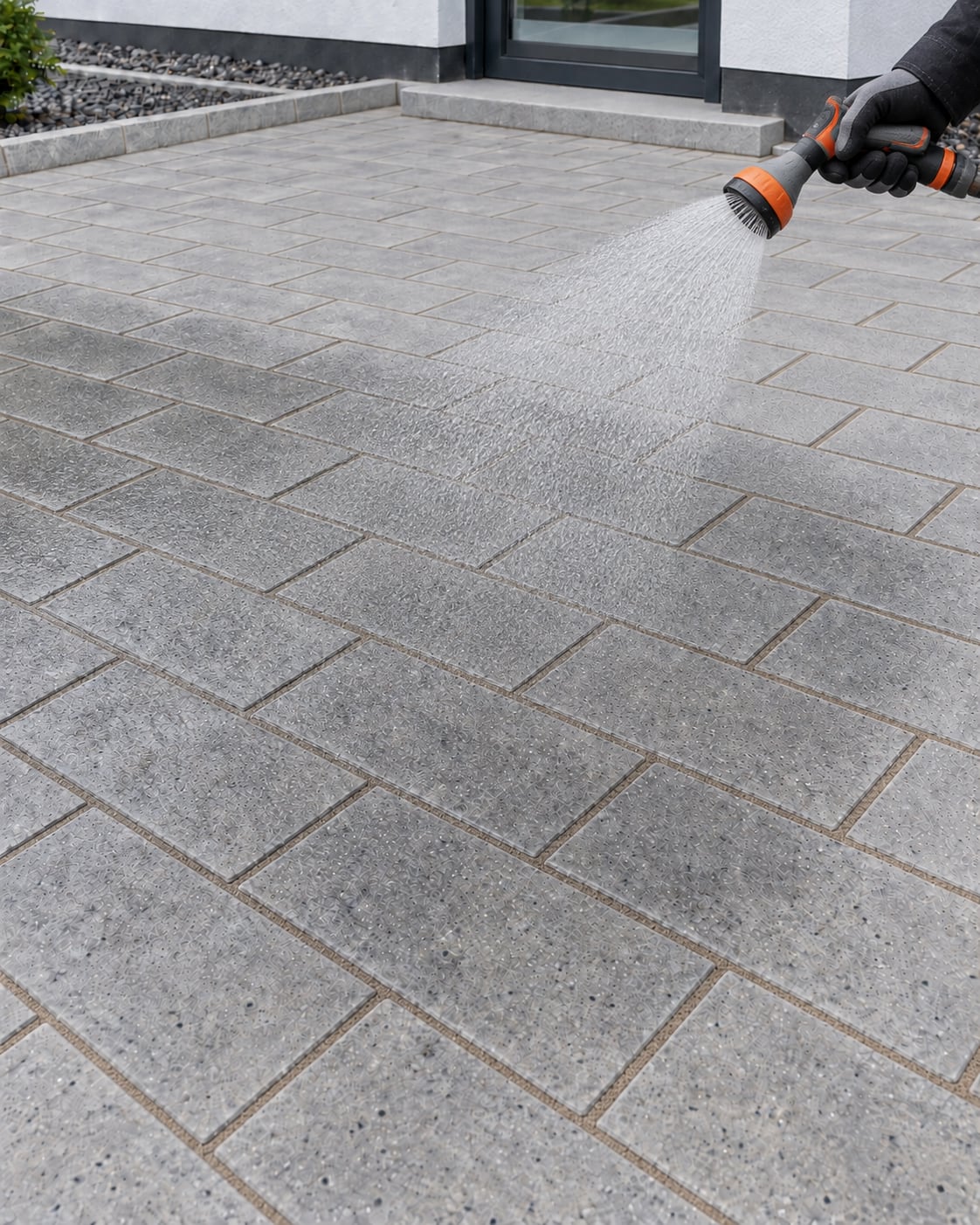
Start at the lowest point of the area and water evenly with clean water in small sections. Use an adjustable nozzle with a gentle shower spray. Do not wash any material out of the joints.
Repeat the process several times until the material is saturated with water throughout the entire filling depth. Do not flood the area or allow it to dry out completely between watering passes.
Check wetting throughout the depth
Use a spatula or a similar tool at several points to check whether the jointing material is thoroughly wetted. Its condition throughout the entire filling depth is what matters.
For large slabs with narrow joints, water can be applied directly to the joints using a sprayer or pressure sprayer until they are fully saturated.
Remove puddles and residue
Remove standing water and material residue with a sponge, squeegee or leaf blower. If material remains on the paving units, rinse it into the joints or off the edge of the paved area.
If foaming occurs, reduce the water pressure and finish by rinsing everything thoroughly again without pressure. Dried residue can leave a haze on the paving surface that requires considerable effort and specialist cleaners to remove.
Then allow to dry completely
Protect the area from rain and keep off it for the first three hours. The stated times for pedestrian access and rain resistance refer to 20 °C and approximately 50 % relative humidity.
Being ready for pedestrian access does not mean the material has dried completely: full drying and strength development can take several days, depending on the weather. Readiness for vehicle traffic is reached after approximately three days and depends on temperature and weather conditions.
Do not cover the area in dry weather, so that the joints can dry throughout.
Why does drying sometimes take longer?
In addition to temperature, relative humidity and air movement affect how quickly water evaporates from the joints. Drying can take considerably longer in cool, humid and still conditions than in warm, dry weather with air movement.
Dew may form on the surface at night if it cools sufficiently. This additional moisture can delay drying further. Strength development therefore depends on how dry the material actually is, not just on the time that has passed since installation.